
August 24, 2026
Gopher Tortoise Burrows: The Permit That Can Stop a Pool Build Before It Starts
A gopher tortoise burrow within 25 feet of your pool excavation needs an FWC relocation permit first. What that means for a Tampa Bay backyard.
By Pool Pros (CPC1461047) · August 24, 2026 · Homeowner Resources
There is a version of a backyard pool project that goes wrong before anyone has drawn anything. It starts with a hole in the sand near the back fence — wider than it is tall, flattened at the bottom, half hidden under a palmetto — that the homeowner has walked past for six years without thinking about.
That hole is a gopher tortoise burrow, and in Florida it carries a legal weight that surprises almost everyone who finds one on their own property.
What the law actually says
The gopher tortoise is state-listed as Threatened in Florida, and the state’s existing protections remain in place. In practical terms, the Florida Fish and Wildlife Conservation Commission (FWC) requires a relocation permit before burrows are disturbed and construction activity proceeds.
The word doing the work there is before. This is not a violation you fix afterwards by paying a fee. The permit is a precondition, and FWC directs members of the public who suspect unpermitted work near a burrow to its Wildlife Alert Hotline.
The number that matters is 25 feet
FWC’s definition is specific, and it is broader than most people assume:
A disturbance includes any type of work within 25 feet of a gopher tortoise burrow.
Read that as a builder reads it. Twenty-five feet is not measured from the burrow to the edge of the swimming pool. It is measured from the burrow to any work — and a pool excavation is far more than the pool.
An excavator needs to reach the hole, which means a tracked machine crossing the yard. The spoil from a pool dig has to go somewhere, and on a lot where it isn’t being hauled off it goes into a pile. Steel, block, plumbing and shotcrete hose all need staging room. The equipment pad needs a trench for conduit and pipe. Every one of those is work.
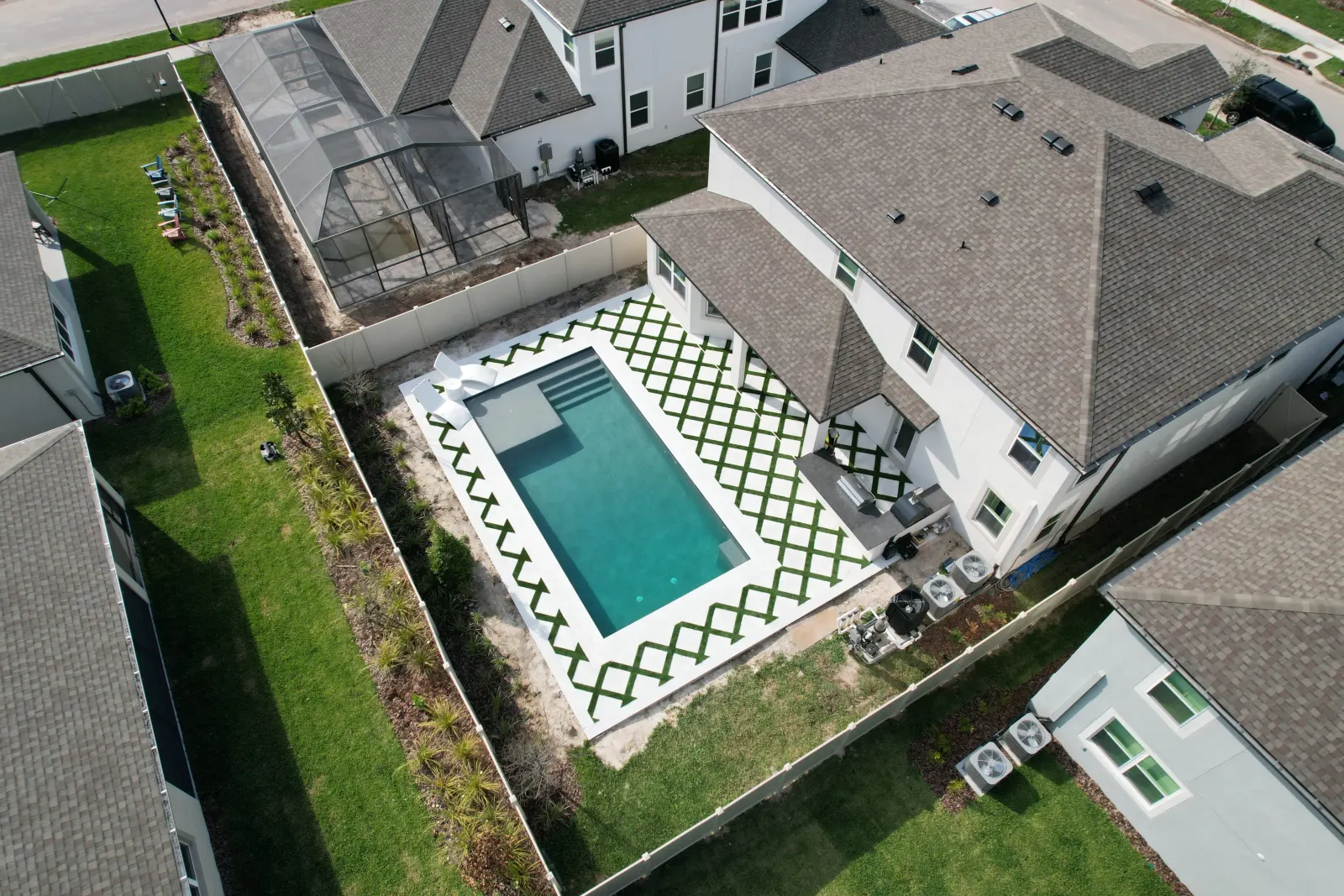
So the honest way to picture the trigger is not a circle drawn around the pool. It is a circle drawn around everything the project touches — and that circle is a great deal bigger than the blue rectangle on the drawing.
The good news, and it’s genuinely good
FWC also states the other side of it plainly:
Even if gopher tortoise burrows are present on your property, you may not need a permit if all development activity will avoid burrows and tortoises by at least 25 feet.
This is the outcome worth designing toward, and it reframes the whole problem. A burrow on your lot is not a verdict on whether you can have a pool. It is a constraint on where the pool goes — the same kind of constraint as a septic drainfield, an easement or a mature oak you don’t want to lose.
On a big Pasco or east Hillsborough lot, that is often no hardship at all. Shifting a pool fifteen feet toward the house, rotating it, or moving the equipment pad to the other side of the property can be the whole solution. The cost of doing that at the design stage is zero. The cost of discovering it after a contract has fixed the pool’s position, the permit is in, and the crew is scheduled is not zero.
Why on-site relocation is harder than it sounds
Where the pool truly cannot move, relocation is the path, and FWC’s 10 or Fewer Burrows permit is the relevant instrument for a residential lot. It allows tortoises to be relocated on the property where suitable habitat will remain.
But look at what “suitable habitat” has to be. FWC’s criteria for an on-site recipient area require:
- at least 750 square feet of suitable gopher tortoise habitat,
- at least 10 feet wide (FWC’s own example is a 10 ft by 75 ft strip),
- with half of the recipient area at least 25 feet from construction boundaries.
Now hold that against a typical suburban backyard that already has a house, a drainfield or a sewer lateral, a fence line, an air conditioning pad and a proposed pool in it. Seven hundred and fifty square feet of genuinely suitable, undisturbed habitat — half of it standing 25 feet clear of everything you are about to build — is a real amount of land. Large rural lots can often produce it. Quarter-acre lots frequently cannot, and then the conversation moves to off-site relocation and a different permit track.
None of that is a reason for despair. It is a reason to find out early.
What this means for sequencing a build
The practical lesson has nothing to do with tortoises and everything to do with order of operations.
A burrow survey is cheap and fast when it happens during design, while the pool is still a shape that can be moved on a drawing. It is expensive and slow when it happens after the design is fixed, because by then every option except the permit has been engineered away.
So if your lot is sandy, open, high and dry — the kind of ground gopher tortoises like, which describes a great deal of Pasco County and the eastern half of Hillsborough — the burrow question belongs in the same early conversation as soil, setbacks and where the equipment pad will sit. Not the week before the dig.
FWC’s permitting framework is built around burrow surveys and authorized agents precisely because assessing burrows is specialised work. If there is a suspicious hole on your property, the useful move is to treat it as a survey question rather than a judgement call, and to raise it before anything is fixed.
That is the entire article, really: the tortoise is not the problem. Finding it late is.
References
Sources cited in this article:
Ready to talk about your own pool?
Tell us about the space you have and the pool you're picturing — we'll take it from there.