
September 15, 2026
High Water Table in Pinellas: What It Changes About Your Pool
Groundwater near the surface changes how a pool is dug, what the code requires in the floor, and why the pool must never be emptied casually.
By Pool Pros (CPC1461047) · September 15, 2026 · Builder Insight
Here is the mental model that makes everything about building on the Pinellas coast make sense:
A swimming pool is a boat, and the water inside it is the ballast.
An empty concrete shell sitting in wet ground is a hull displacing groundwater. Fill it and it is far too heavy to float. Empty it and it isn’t. Everything below follows from that one idea.
What is under a Pinellas lot
Pinellas is a peninsula, and it has a shallow aquifer under most of it. USGS mapped this in detail: the surficial aquifer in Pinellas County contains potable water throughout most of the county and has a saturated thickness of more than 30 feet through most of it.
Saturated thickness is not the same as depth to water — it describes how much water-bearing material is down there, not how far you dig before you find it. But it tells you the important thing: this is not a lot with a bit of damp at the bottom. There is a substantial, continuous body of groundwater beneath most of the county, and it responds to rainfall and to the season.
FDEP publishes a statewide Estimated Depth to Water Table map for the surficial aquifer system, which is a good orientation tool. It is a regional estimate rather than a measurement of your backyard, which matters, because the number that changes your build is the one from a boring on your lot.
What the code requires because of it
The Florida Building Code deals with this in one short line, section R4501.21.4:
In areas of anticipated water table an approved hydrostatic relief device shall be installed.
The only exception is for plastic liner pools, which have no structural bottom to lift.
A hydrostatic relief device is a one-way valve in the floor of the pool. When pressure underneath the shell exceeds pressure inside it, the valve opens and lets groundwater in. That sounds like a defect and it is the opposite: it is a deliberate pressure release. Better a few gallons of groundwater in the pool than the entire shell lifting.
It is a small part with a large job, and it is the part a homeowner never sees, never thinks about, and depends on completely.
What shallow groundwater does to the build itself
The finished pool is only half of it. The construction is where high groundwater shows up first, and this is the part that separates builders who work this ground routinely from those who don’t.
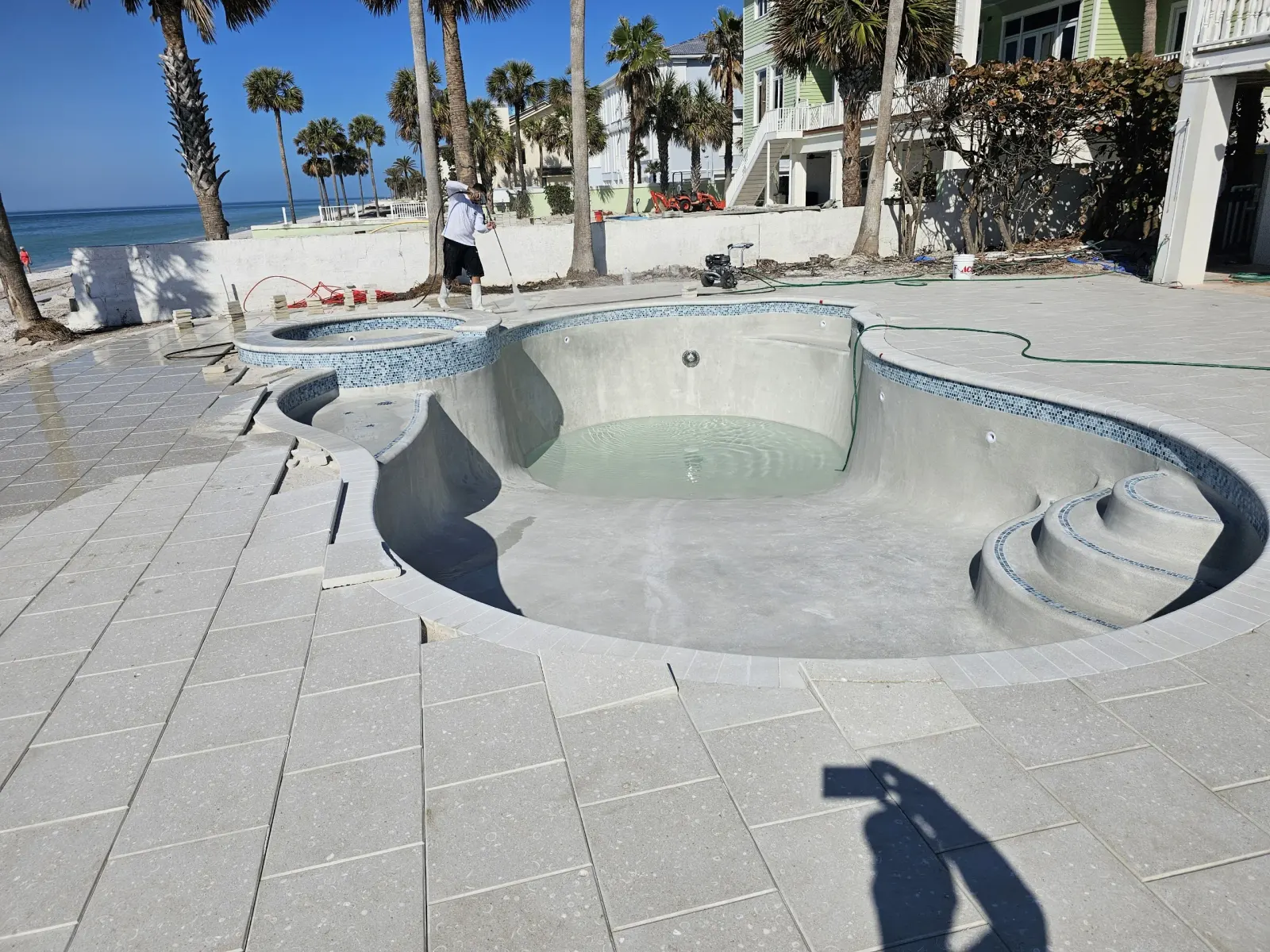
The hole fills up. Dig into the water table and the excavation becomes a pond. You cannot place steel and shoot a shell into standing water, so the site has to be dewatered — pumped down and held down for as long as the work takes. On a wet lot this is a planned, priced, scheduled part of the job. On a job priced by someone who assumed dry sand, it is a surprise, and surprises mid-excavation get resolved badly.
Timing against rainfall matters. Groundwater is not a fixed number. It rises through the wet season and after heavy rain, and Tampa Bay’s summer delivers plenty of both. An excavation that would have been straightforward in April can be a different job in August.
Depth stops being free. Every extra foot of shell displaces more water and has to resist more uplift, and it takes the excavation further into the saturated zone. On dry ground, depth is mostly a question of taste and diving safety. Here it has an engineering price attached, which is worth knowing before you fall in love with a drawing.
What it means for owning the pool
One rule, and it is the one that matters most: do not empty the pool casually.
This surprises people, because draining a pool feels like basic maintenance — the way you’d empty a bath to clean it. On ground like this, the water in your pool is a structural component. Take it out and you have removed the only thing holding a large buoyant object down against groundwater that is still pushing up.
That does not mean a pool here can never be emptied. Resurfacing exists; so do repairs that genuinely require a dry shell. It means emptying is a planned operation — one that accounts for what the water table has been doing, uses the relief device properly, is timed against recent rainfall, and sometimes runs active dewatering alongside. It is work for someone who has done it on this ground before.
The version that goes wrong is always the same: a well-meaning owner, a rented pump, a rainy week, and a shell that lifts, cracks or tilts. That is not a repair. That is frequently a replacement.
The same principle is why draining a pool ahead of a hurricane — which sounds so sensible — is the wrong move, and we have written that up separately in Should you drain your pool before a hurricane?.
The short version
Pinellas is excellent pool country. It is also ground where the water beneath the lot is an active participant in the project, during construction and for the life of the pool.
Three things follow: know the water table before the design is fixed, make sure the hydrostatic relief device is there and correctly installed, and never let anyone empty the pool without a reason and a plan.
Code references reflect the Florida Building Code as published on 17 August 2026 and are re-verified quarterly. Site-specific groundwater conditions require a geotechnical investigation; this article is general information, not an assessment of any property.
References
Sources cited in this article:
- Florida Building Code, Residential (2023, 8th ed.) §R4501.21.4 — hydrostatic relief device (retrieved 17 August 2026)
- U.S. Geological Survey — The surficial aquifer in Pinellas County, Florida (Water-Resources Investigations Report 84-4289) (retrieved 17 August 2026)
- FDEP Geospatial Open Data — Estimated Depth to Water Table, Surficial Aquifer System (retrieved 17 August 2026)
Ready to talk about your own pool?
Tell us about the space you have and the pool you're picturing — we'll take it from there.