
September 23, 2026
Pool Equipment After a Week Without Power: How to Restart
Before you flip the pool breakers after a long outage: check the pad for water, test the GFCI, prime the pump, then work through filter, salt cell and heater.
By Pool Pros (CPC1461047) · September 23, 2026 · Homeowner Resources
Restart in order. Confirm the equipment pad stayed dry, since Pentair, Jandy and Hayward send flood-exposed equipment to a professional first. Then restore the breakers, test the GFCI, fill the strainer pot and prime the pump, check filter pressure, and bring the salt cell, heater and automation back by their manuals. Never backfeed a generator.
After a week without power, the pool equipment pad can look untouched apart from the leaves. The temptation is to flip every breaker at once and see what runs.
Bring the equipment back one piece at a time instead. Pool Pros Construction builds and services pools across Tampa Bay and installs Pentair, Jandy and Hayward equipment, and the order below follows those manufacturers’ own manuals.
What should you check before turning the pool breakers back on?
The pool equipment pad needs a look before anything gets power. The question is whether floodwater reached the equipment, not whether rain fell on the pad.
- Flooded equipment waits for a professional. Pentair says to have a pool professional inspect equipment exposed to water before powering everything back up. Hayward strongly recommends the same for flood-exposed electrical or gas equipment, and excludes it from warranty coverage.
- Heaters carry their own warning. The Jandy JXi gas heater and Pentair UltraTemp heat pump manuals both say not to use the unit if any part has been under water, and to have a qualified service technician replace any part of the control system that was.
- OSHA agrees on electrical gear generally. Its generator fact sheet says not to use electrical equipment that has been submerged until the equipment is thoroughly dried out and properly evaluated.
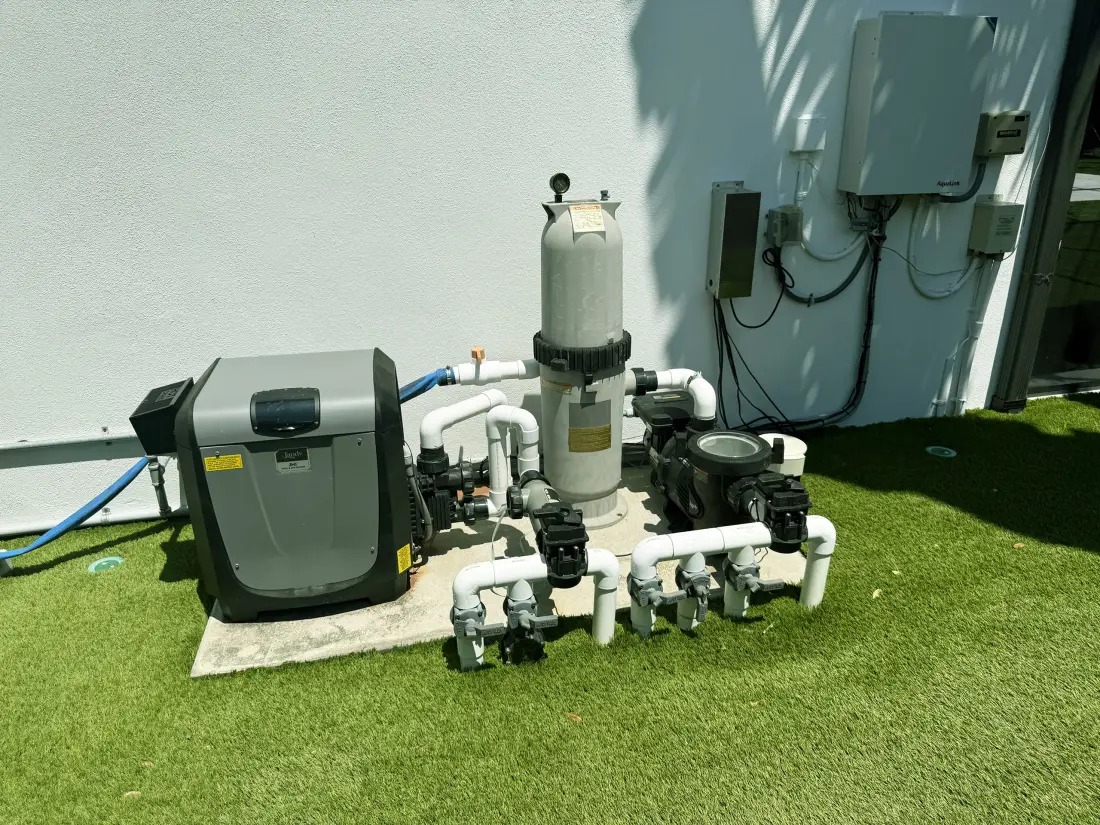
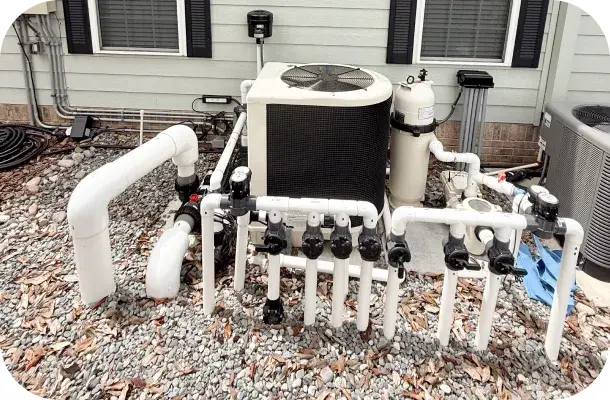
- Clear debris off the pad. Pentair’s UltraTemp manual says to keep objects off the top of a heat pump, because blocked airflow can damage the unit, and to keep the drain holes in its base clear.
If the pad flooded, stop here and read what to check after a storm before anyone swims. Everything below assumes it stayed dry.
How do you restore power and test the GFCI?
The GFCI test comes right after the breakers. The Pentair IntelliFlo3 and Hayward Super Pump manuals give the same procedure: push the test button and power should cut off, then push reset and power should return.
Two results mean the equipment stays off until a qualified service representative has checked the system. A GFCI that doesn’t cut power when tested is defective, according to both manuals. A GFCI that trips on its own, without the test button, means ground current is flowing and a shock is possible.
How do you prime the pool pump after a week off?
A pool pump that has sat for a week needs its strainer pot checked before it starts. Both manufacturers are blunt about running dry: Hayward says never to run the pump dry, because water cools and lubricates the shaft seal. Pentair’s steps for priming its IntelliFlo3:
- Stop the pump and turn off its power at the breaker.
- Close the valves in the suction and return lines.
- Open the filter’s air relief valve and stand clear until the pressure gauge reads zero.
- Remove the strainer pot lid and fill the pot with water up to the suction port.
- Replace the lid, making sure the O-ring is seated and not pinched.
- Open the valves, open the air relief valve again and stand clear of the filter.
- Restore power and start the pump.
- Close the air relief valve once a steady stream of water comes out.
Pentair says not to let the pump run longer than 30 minutes without priming. Hayward’s manual is stricter for its Super Pump: stop the motor and find the cause if the pump hasn’t primed within five minutes. Hayward lists an empty strainer housing, suction air leaks and a basket loaded with debris among the causes to check.
Check the water level too. Pentair’s guide calls for water halfway up the skimmer opening, because a lower level lets the pump draw air and lose prime. If storms left the pool overfull, bring it down only after the ground has dried, for the reasons in should you drain your pool before a hurricane.
What should the filter gauge tell you?
The filter gauge is the next check once water is moving. Pentair’s Clean & Clear Plus guide calls the pressure gauge the primary indicator of how the filter is operating, and says to clean a cartridge filter when pressure reads about 10 psi above its original starting pressure or when flow drops noticeably.
A reading that falls instead of rising points somewhere else. The same guide says to check the skimmer and pump baskets for debris first, and if the baskets are clean, the problem is likely the pump.
How do the salt cell, heater and automation come back?
The rest of the pad depends on steady flow, so each piece comes back after the pump and filter are right.
| Equipment | What to check after a long outage | Source |
|---|---|---|
| Salt system | No Flow light off, salt and stabilizer tested, cell plates free of scale | Hayward AquaRite and Pentair IntelliChlor manuals |
| Gas heater | Smell around the unit for gas first; pump on, filter clean, water flowing | Jandy JXi manual |
| Heat pump | Pump on and water flowing; allow the sensing and compressor delays | Pentair UltraTemp manual |
| Automation | Power-loss warnings reviewed, schedules and connection confirmed | Pentair IntelliCenter and IntelliFlo3 guides |
Why isn’t the salt system making chlorine?
A salt cell makes nothing without flow. Hayward’s AquaRite stops generating when its flow switch detects no flow, and Pentair’s IntelliChlor produces no chlorine without adequate flow.
Salt and stabilizer can both be low after a week of storms. Hayward’s AquaRite manual says salt is lost mainly when water leaves the pool, including draining after rain, and that stabilizer usually drops with it. A pool that went a week without chlorine may also be green, which clearing a green pool after an outage covers.
Why won’t the pool heater start?
Pentair UltraTemp heat pumps and Jandy JXi gas heaters both appear among the pool equipment systems on Pool Pros projects, and both manuals tie the heater to the pump. The UltraTemp needs the pool pump on and water flowing, and the JXi manual says to check that the filter pump is on, the filter is clean and water is flowing if the heater won’t start.
A gas heater gets a sniff test first. Jandy’s JXi manual says to smell all around the appliance, including near the floor, before operating the heater. If you smell gas, don’t touch any electric switch, and call the gas supplier from a neighbor’s phone.
A heat pump may simply be waiting. Pentair’s UltraTemp manual describes a one-minute sensing delay after the water pressure switch activates and another five minutes before the compressor starts.
Does the pool automation need attention?
Pool automation should be checked against its own manual. Pentair’s IntelliCenter logs a system power loss as a warning, and the IntelliFlo3 app reports a pump as offline after an outage at the pump or router. Confirm the schedules still run the way Pool Pros or your installer set them.
Can you run pool equipment on a generator?
A portable generator can power plug-in appliances, but pool equipment is a different case. Hayward’s Super Pump and AquaRite manuals both say not to use an extension cord to connect the unit to its power supply.
Connecting a generator to the house is the dangerous shortcut. OSHA says never to attach a generator directly to a home’s electrical system unless a qualified electrician has installed the generator with a transfer switch, because a direct connection can energize wiring for great distances and put utility workers at risk. CPSC has warned that male-to-male cords used to backfeed a home carry risks of electrocution and fire.
Placement matters as much as wiring:
- Outdoors only. CPSC says never to run a portable generator in a home, garage, basement, crawlspace or shed, even with doors or windows open.
- At least 20 feet away. CPSC sets that distance from homes and buildings, with exhaust directed away from windows, doors and vents. Ready.gov gives the same 20 feet from windows, doors and attached garages.
- Carbon monoxide alarms. CPSC recommends working alarms on every level and outside sleeping areas.
Pool Pros’ advice is to let the pool wait for utility power, or for a transfer switch an electrician has installed. Green water can be cleared later.
References
Sources cited in this article:
- Jandy: JXi Gas-Fired Pool and Spa Heater Installation and Operation Manual, H0574300 (retrieved September 14, 2026)
- Pentair: UltraTemp Heat Pump Installation and User's Guide (retrieved September 14, 2026)
- Pentair: IntelliFlo3 VSF and IntelliPro3 VSF Installation and Maintenance Guide (retrieved September 14, 2026)
- Hayward: Super Pump Series Owner's Manual, IS26001 Rev-B (retrieved September 14, 2026)
- Pentair: Clean & Clear Plus Cartridge Filter Installation and User's Guide (retrieved September 14, 2026)
- Hayward: AquaRite Electronic Chlorine Generator Owner's Manual, W3AQR15/W3AQR9/W3AQR3, 092540 Rev G (retrieved September 14, 2026)
- Pentair: IntelliChlor Salt Chlorine Generator Installation and User's Guide, IC15/IC20/IC40/IC60 (retrieved September 14, 2026)
- Pentair: IntelliCenter Control System User's Guide (retrieved September 14, 2026)
- Pentair: Tropical Storm Pool Protection (retrieved September 14, 2026)
- Hayward: Hurricane Preparedness (retrieved September 14, 2026)
- OSHA: Using Portable Generators Safely, fact sheet OSHA3286 (retrieved September 14, 2026)
- CPSC: CPSC Warns of Generator, Carbon Monoxide and Fire Hazards Ahead of Hurricane Season, May 27, 2026 (retrieved September 14, 2026)
- CPSC: Warning on Huizhou Xiyan Digital male-to-male extension cords, March 31, 2026 (retrieved September 14, 2026)
- Ready.gov: Power Outages (retrieved September 14, 2026)
Ready to talk about your own pool?
Tell us about the space you have and the pool you're picturing — we'll take it from there.