
August 22, 2026
Florida's Pool Barrier Law: What It Actually Requires of a New Pool
A new Florida pool must have at least one of five safety features to pass final inspection. What section 515.27 lists, and what the barrier itself must do.
By Pool Pros (CPC1461047) · August 22, 2026 · Homeowner Resources
Florida leads the nation in drowning deaths among children ages one to four. As of 27 July 2026, seventy-six children had died by drowning in Florida this year according to Department of Children and Families data reported by WUSF, against 119 for the whole of last year — a pace that puts 2026 on track to be the deadliest year on record.
That is the reason this article exists, and it is the reason we treat this particular topic differently from every other one on this site. Everything below is cited to the statute or the code section it comes from, so you can check it yourself rather than take a contractor’s word for it.
Two different laws, constantly confused
Almost every argument we hear about “the pool fence law” comes from running two separate statutes together.
Section 515.27 answers: what does a new pool need in order to pass final inspection?
Section 515.29 answers: if you choose a barrier, what does that barrier have to be?
They are not the same question, and the first one is far more permissive than most homeowners expect.
What a new pool actually needs: one of five things
Under section 515.27, a new residential swimming pool must meet at least one of five safety feature options to pass final inspection:
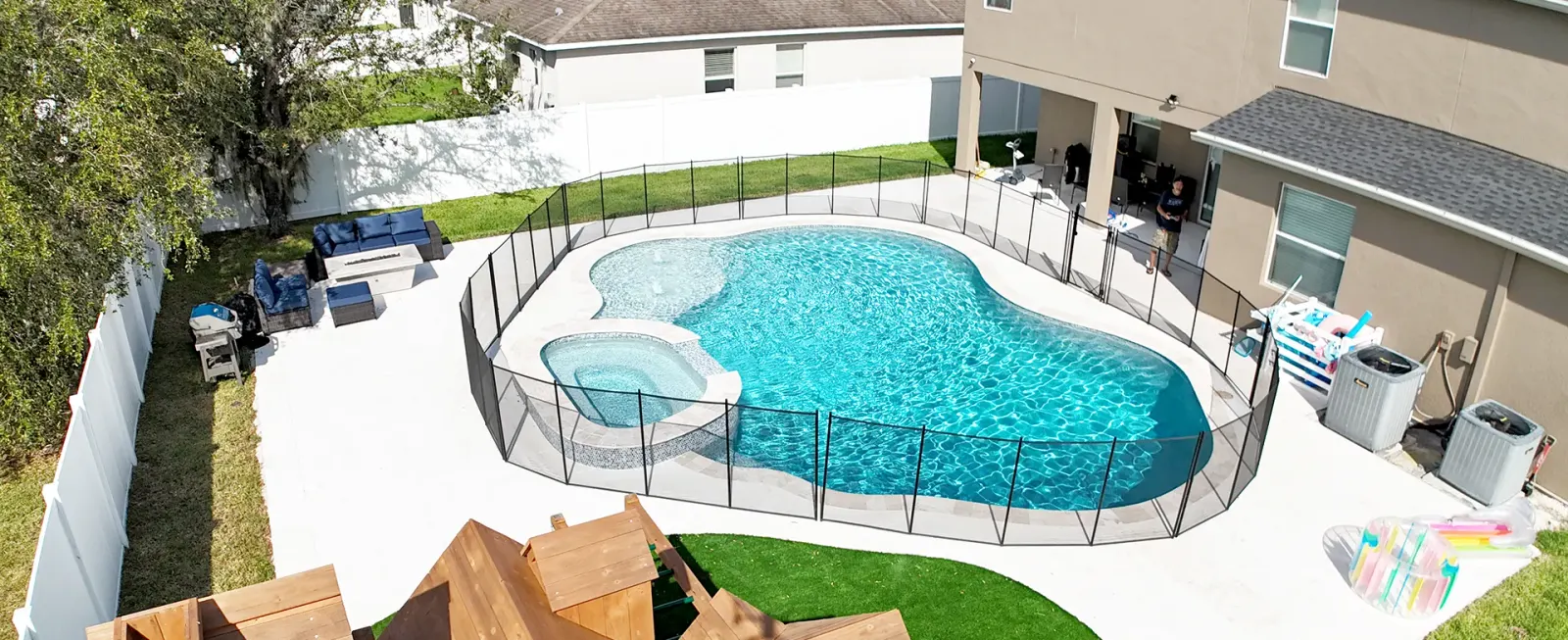
- A barrier. The pool is isolated from access to the home by an enclosure meeting the pool barrier requirements.
- An approved safety pool cover.
- Exit alarms. All doors and windows providing direct access from the home to the pool are equipped with an exit alarm with a minimum sound pressure rating of 85 dB A at 10 feet.
- Self-closing, self-latching doors. All doors providing direct access from the home to the pool have a self-closing, self-latching device with the release mechanism placed no lower than 54 inches above the floor.
- A pool alarm certified to ASTM Standard F2208, which detects accidental or unauthorised entry into the water. Personal wearable alarms do not count.
Read option 3 carefully, because it is the one people misremember: it says doors and windows. A lanai slider is obvious. The bedroom window that opens onto the pool deck is the one that gets missed.
And note that “at least one” is a floor set by state law, not a ceiling. Your county or municipality can require more, and layering is the whole point — CPSC’s guidance describes barriers as providing “layers of protection for a child when there is a lapse in adult supervision,” not as a single sufficient device.
If you choose a barrier, here is what it has to do
Section 515.29 sets the performance standard. A barrier must:
- be at least 4 feet high on the outside;
- have no gaps, openings, indentations, protrusions or structural components that would let a young child crawl under, squeeze through, or climb over it;
- be placed around the perimeter of the pool and be separate from any yard fence or wall, unless that fence sits on the pool perimeter, is being used as part of the barrier, and itself meets the section’s requirements;
- be placed sufficiently far from the water’s edge that a child who does get through it does not immediately fall in.
The Florida Building Code carries the same requirements in enforceable detail. Section R4501.17.1 states the minimum as 48 inches above grade; R4501.17.1.2 requires that the barrier not pass a 4-inch-diameter sphere and prevent a young child crawling under or climbing over.
That 4-inch sphere is worth picturing, because it is the dimension that quietly rules out a lot of attractive fencing. So is the anti-climb requirement — a horizontal rail is a ladder rung to a determined three-year-old. CPSC’s guidance addresses this directly: where a barrier is made of horizontal and vertical members less than 45 inches apart, the horizontal members should be on the pool side of the fence, and spacing between vertical members should not exceed 1¾ inches.
Gates are where compliance usually fails
Section 515.29 is specific, and the Building Code repeats it at R4501.17.1.8. Gates providing access to the pool must:
- open outward, away from the pool;
- be self-closing;
- be equipped with a self-latching locking device;
- have the release mechanism on the pool side, positioned so that it cannot be reached by a young child over the top of the gate or through any opening or gap.
CPSC adds the dimension the statute leaves out: where the release is less than 54 inches from the bottom of the gate, it should sit at least 3 inches below the top of the gate on the pool side, and the gate and barrier should have no opening greater than ½ inch within 18 inches of that release.
A gate that self-closes but does not self-latch is not compliant. Neither is one propped open, which is the most common failure of all and the one no inspection will ever catch for you.
The house as part of the barrier
If a wall of the dwelling forms part of the barrier, the Building Code (R4501.17.1.9) requires one of: exit alarms rated at least 85 dBA, self-closing doors with the release at 54 inches or higher, or an ASTM F2208 pool alarm.
CPSC’s own position on that arrangement is blunt, and we quote it in full in our companion article on four-sided fencing: a fence completely surrounding the pool is better than one with the house serving as the fourth side.
The penalty, and the 45 days
This is the part almost no builder page mentions. Failing to equip a new residential swimming pool with at least one of the required safety features is a misdemeanor of the second degree under Florida law.
The statute also provides a cure. The penalty is waived if the owner installs a compliant safety feature within 45 days and completes a drowning prevention education program, where one is available.
That cure provision is genuinely useful to know about. It is not a reason to treat the requirement casually.
What we do about it
Barrier compliance is a design-stage decision, not a punch-list item. Which of the five options you choose changes the deck layout, where gates go, whether the screen enclosure has to be built to barrier standard, and what the doors from the house need on them. Deciding it at final inspection means retrofitting.
We hold a Florida contractor licence (CPC1461047), and pool barriers are the one area where we will not simply build what a customer draws if what they have drawn will not comply. This article is the reasoning behind that.
Code and statute change. This article reflects the law as published on 17 August 2026 and is re-verified quarterly. Your local building department is the authority for your specific address — confirm with them before relying on any summary, including this one.
References
Sources cited in this article:
- Section 515.27, Florida Statutes — Residential swimming pool safety feature options (retrieved 17 August 2026)
- Section 515.29, Florida Statutes — Residential swimming pool barrier requirements (retrieved 17 August 2026)
- Florida Building Code, Residential (2023, 8th ed.), Chapter 45 — Private Swimming Pools, §R4501.17 (retrieved 17 August 2026)
- U.S. Consumer Product Safety Commission — Safety Barrier Guidelines for Residential Pools, Publication 362 (retrieved 17 August 2026)
- WUSF — Florida is on track for deadliest year on record for childhood drownings, 27 July 2026 (retrieved 17 August 2026)
Ready to talk about your own pool?
Tell us about the space you have and the pool you're picturing — we'll take it from there.