
August 22, 2026
Four-Sided Isolation Fence or the House as the Fourth Wall?
Both can satisfy Florida's pool safety law. They are not equally safe, and the CPSC says so plainly. What each choice means for a Tampa Bay backyard.
By Pool Pros (CPC1461047) · August 22, 2026 · Homeowner Resources
There are two ways to enclose a pool in Florida, and both of them are legal.
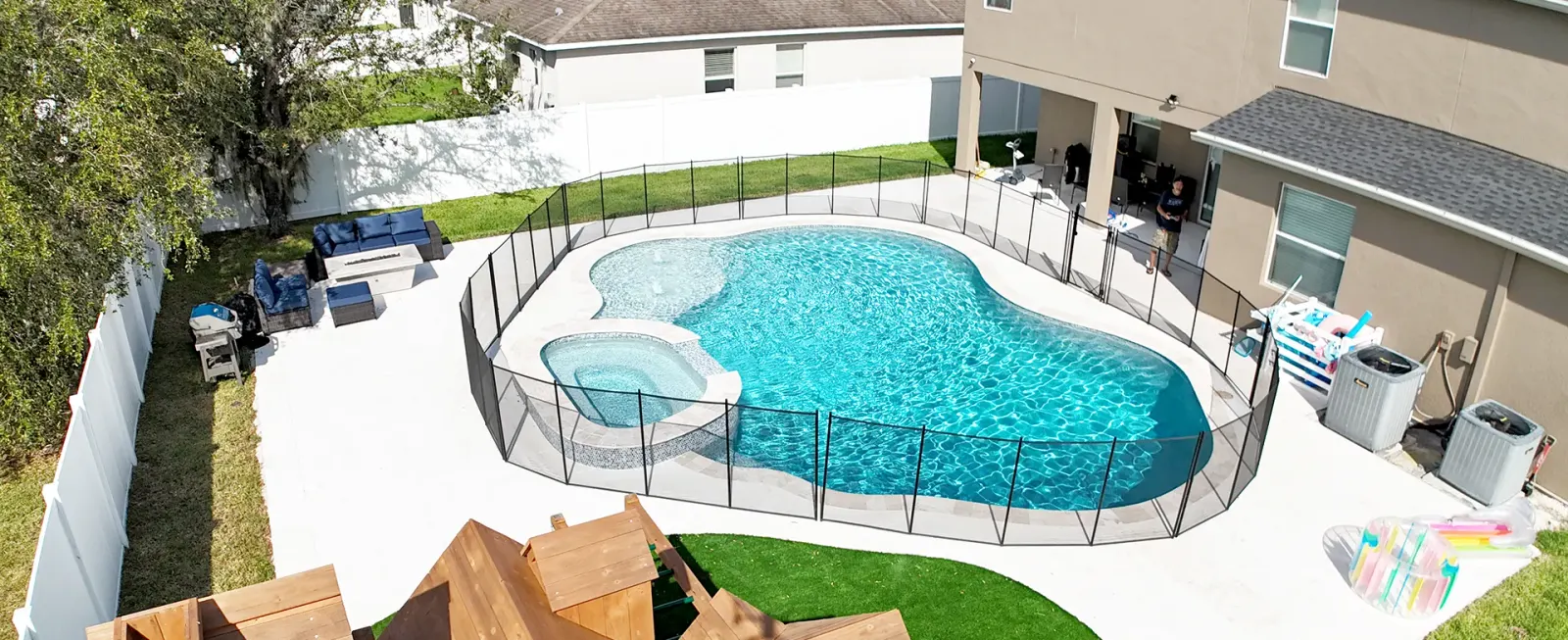
Option one puts a barrier around the pool itself, so the pool sits in its own compartment inside your yard. Walk out of the house and you are in the garden; to reach the water you pass through a gate.
Option two uses the back wall of the house as one side of the barrier, with the yard fence forming the rest. Walk out of the house and you are at the pool.
Almost every Tampa Bay backyard we look at wants option two, for obvious and completely understandable reasons. It costs less, it doesn’t chop the garden in half, and it doesn’t put a fence between the lanai and the water.
We build both. But we are not going to pretend they are the same thing, because the federal guidance doesn’t.
What the CPSC actually says
The U.S. Consumer Product Safety Commission’s Safety Barrier Guidelines for Residential Pools is the reference document behind most residential pool barrier codes in the country. On this exact question it is one sentence long:
A fence completely surrounding the pool is better than one with the house serving as the fourth side. Fences should be a minimum of 4 feet high, although fences 5 feet or higher are preferable.
That is the whole comparison, from the agency whose job it is to make it. It is not hedged, and it is not buried — it is in the opening recommendations, under the heading “Fences.”
Note the second sentence too. Four feet is Florida’s statutory minimum. CPSC’s preference is five.
Why the difference exists
An isolation fence works whether or not anyone in the house is paying attention. That is its entire value. A child who gets out of the back door is in the garden, not at the water, and something else has to fail before they reach the pool.
When the house is the fourth wall, the barrier is made partly of habits. Florida law accommodates this: if the dwelling wall forms part of the barrier, the Building Code requires exit alarms of at least 85 dBA, or self-closing doors with the release at 54 inches or higher, or a pool alarm meeting ASTM F2208.
Those are real protections and they work. But look at what they have in common — every one of them is a device on a door that people use forty times a day, in a house where somebody is carrying groceries, letting the dog out, and running the air conditioning against an August afternoon.
The failure mode isn’t dramatic. It’s a slider propped open because the alarm was chirping. It’s a self-closing hinge that got adjusted after it slammed on someone’s fingers. It’s a battery nobody replaced. None of those leave a mark, and none of them look like anything is wrong. The wall is simply not there any more.
An isolation fence can also fail — a gate propped open is exactly the same failure. But it fails one gate at a time, and a gate you have to walk to and open on purpose gets propped open a great deal less often than the door you carry the shopping through.
The pet door problem
This one is specific to option two, and CPSC is unusually direct about it:
Never have a pet or doggy door if the door leads directly to a pool or other backyard water.
And, crucially: locking it is not enough. CPSC’s stated remedy is an isolation barrier — “An isolation barrier or fence is the best defense when pet doors are installed.”
If you have a dog and you want a dog door, that is not a small preference to weigh against the fence. In this arrangement it is a hole in the barrier that the code’s door alarms do not cover.
What each choice costs you in design
We would rather tell you the honest trade-offs than sell you the safer option by omission.
An isolation fence costs you:
- Deck geometry. The fence has to stand far enough from the water that getting through it doesn’t mean falling in, which eats deck width on whichever side it runs.
- Sightlines. A four- or five-foot fence between the lanai and the pool changes the view from inside the house. Materials help enormously here — aluminum picket, glass panel, or a removable mesh fence read very differently from solid privacy fencing.
- A gate you will use constantly, so its position and swing matter more than people expect.
The house as the fourth wall costs you:
- Ongoing discipline from everyone who lives in or visits the house, indefinitely.
- Hardware on every opening with direct pool access — and remember section 515.27’s exit-alarm option covers doors and windows.
- The pet door, effectively.
The screen enclosure question
In Tampa Bay there is a third path that people rarely consider early enough: a screen enclosure built to barrier standard can be the isolation barrier.
This works, but only if it is designed that way from the start. The cage has to meet the barrier requirements — adequate height, nothing climbable, no opening passing a 4-inch sphere, and doors that open outward, self-close and self-latch with the release on the pool side. A cage priced and engineered purely to keep no-see-ums out will not automatically satisfy any of that.
Because the cage is engineered before it is built, this is a decision with a deadline. It costs very little to specify a barrier-compliant enclosure at the outset and a great deal to retrofit one afterwards.
What we recommend
If there are young children in the house or likely to visit it, we recommend the isolation fence, and we recommend five feet rather than four. That is CPSC’s position and we have no reason to soften it.
If you choose the house as the fourth wall — which is a legitimate, lawful choice that many households make well — then choose it deliberately: no pet door toward the pool, alarms on windows as well as doors, and a plan for who checks the hardware still works. Layer a second feature on top of the one the statute requires. The law asks for one; nothing stops you having two.
The worst version of this decision is the one that gets made by default, at final inspection, because nobody raised it while the deck was still a drawing.
This article reflects federal guidance and Florida law as published on 17 August 2026, and is re-verified quarterly. Your local building department is the authority for your address. See also: Florida’s pool barrier law — what it actually requires of a new pool.
References
Sources cited in this article:
- U.S. Consumer Product Safety Commission — Safety Barrier Guidelines for Residential Pools, Publication 362 (retrieved 17 August 2026)
- Section 515.27, Florida Statutes — Residential swimming pool safety feature options (retrieved 17 August 2026)
- Section 515.29, Florida Statutes — Residential swimming pool barrier requirements (retrieved 17 August 2026)
- Florida Building Code, Residential (2023, 8th ed.), §R4501.17.1.9 — dwelling wall as barrier (retrieved 17 August 2026)
Ready to talk about your own pool?
Tell us about the space you have and the pool you're picturing — we'll take it from there.