
September 17, 2026
Lovebug Season and Your Pool: When It Hits, What Helps
UF/IFAS puts Florida's lovebug flights in April-May and August-September. What the swarms do to a Tampa Bay pool, and why a screen enclosure helps.
By Pool Pros (CPC1461047) · September 17, 2026 · Homeowner Resources
Florida's lovebugs emerge in two generations, each lasting about four weeks, in April-May and August-September, according to UF/IFAS. In a pool they are floating debris: skim before dark, empty the skimmer and pump baskets more often, and test before adding chemicals. UF/IFAS says sprays and repellents don't control them and lists screens over pools as a way to avoid them.
Late summer in Tampa Bay comes with a small black fly that travels in pairs. For a few weeks the skimmer basket fills fast and the net comes out every evening.
Lovebugs are well studied. UF/IFAS entomologists have published on their timing, their habits and the myths about them. Pool Pros Construction builds and services pools, and this guide reads that research from the pool deck.
When is lovebug season in Tampa Bay?
Lovebug season in Florida is really two seasons. UF/IFAS reports that each of the state’s two lovebug generations lasts about four weeks, one in April-May and one in August-September. The species has also been collected in Florida in every month except November, so a few stragglers outside those windows are normal.
Lovebug timing also moves with geography. UF/IFAS notes that higher temperatures push populations to peak slightly earlier in the southern parts of the state. Its extension publication cites research finding that locations 20 to 30 miles apart can see quite different emergences, with hotspots that shift from year to year.
Pool Pros works across Pasco, Hillsborough, Pinellas and Manatee counties, and by that research a heavy flight in one of them may say little about another. Judge the season by your own skimmer, not a neighbor’s report from across Tampa Bay.
Why does one yard get more lovebugs than the next?
Lovebug numbers follow habitat. UF/IFAS reports the largest populations in grassy places such as Bahia grass, pastures and roadsides, where the larvae feed on decaying plant material. Mated females look for moist, sandy ground with dead leaves, grass clippings and other decomposing debris.
Two more UF/IFAS findings apply directly to a backyard:
- Lovebugs are weak fliers. Pairs tend to stay within a few hundred yards of where they emerged when the air is calm, and stronger winds pile them against objects downwind.
- Lovebugs gather on light-colored surfaces, especially freshly painted ones.
A pool that backs onto pasture or a mowed roadside sits close to the habitat UF/IFAS describes. A light deck downwind of an open field sits in the path of whatever the breeze delivers.
What do lovebugs actually do to a pool?
Lovebugs in a pool are floating debris. Pairs that come down on the water drift to the skimmer, and a heavy flight can fill the skimmer basket and the pump’s strainer basket quickly.
Lovebugs don’t breed in the water, either. UF/IFAS says females lay their eggs under decaying leaves or grass on land. That makes them a different problem from the frogs that breed in poorly kept Florida pools.
The baskets are where the trouble shows up, and the pump manuals explain why:
- Hayward’s Super Pump manual lists a skimmer or strainer basket loaded with debris among the reasons a pump won’t prime, and a clogged strainer among the causes of low flow.
- Pentair’s IntelliFlo3 guide says the strainer basket should be inspected at least once a week, and that regular emptying improves filter and heater efficiency and spares the motor.
- The same Pentair guide warns that water below the skimmer opening lets the pump draw air, lose prime and run dry, which damages the shaft seal.
Both brands appear among the pool equipment systems on Pool Pros projects, and the owner’s manual for your own pump is the one to follow.
Are lovebugs acidic enough to damage a pool?
The acidity story is about car paint. UF/IFAS explains that smashed lovebugs coat a vehicle’s front end, and it cites measurements showing macerated lovebugs start near neutral, about pH 6.5, then turn acidic, about pH 4.25, within 24 hours. Paint coated with them and held in a humid room for 21 days was not damaged.
The damage UF/IFAS does describe comes from time on a car. Living with Lovebugs points to a coating baked in the sun for an extended period, and the Featured Creatures profile says remains left for several days can etch paint as bacterial action raises the acidity.
Neither UF/IFAS lovebug publication says anything about pool water, interior finishes or pool decks. Nothing in either one ties lovebugs to damage in a pool.
The useful carryover is about cleanup. UF/IFAS says lovebug remains come off surfaces easily if they are not left to bake in the sun, so hose them off the deck, coping and screen the same day.
How should you clean the pool during a lovebug flight?
Lovebug activity follows the sun. UF/IFAS says lovebugs are active only in daylight, less mobile early and late in the day, and do not fly at night. Clearing the water just before dark catches the day’s arrivals in one pass, with no more coming until morning.
- Skim the surface before dark, after the flight has slowed.
- Empty the skimmer baskets at the same time. During a heavy flight, daily is reasonable.
- Look at the pump strainer basket through its lid. To empty it, Pentair’s guide says to shut the pump off at the breaker and open the filter’s air relief valve until the gauge reads zero before removing the lid.
- Refill the strainer pot with water before restarting. Hayward and Pentair both warn never to run the pump dry.
- Keep the water halfway up the skimmer opening, as Pentair’s guide specifies.
- Watch the filter gauge. Hayward’s troubleshooting guide pairs low flow and a high gauge reading with backwashing a sand or D.E. filter, or cleaning a cartridge, per the filter maker’s instructions.
- Test before dosing. CDC recommends that home pools hold pH between 7.0 and 7.8 and at least 1 ppm chlorine, or at least 2 ppm when cyanuric acid is used.
If a storm has passed through as well, read what summer rain does to pool chemistry before chasing pH.
Should you spray for lovebugs around the pool?
Spraying is the step UF/IFAS rules out. The Living with Lovebugs publication says household insecticides will kill adults, but lovebugs return almost immediately, the products carry risks around people and pets, and insects mistaken for lovebugs are sometimes beneficial. UF/IFAS concludes that insecticides are of no value in controlling lovebugs, and that their abundance and mobility put them beyond effective control with poisons or repellents.
UF/IFAS also notes that lovebug larvae are beneficial, because they help break down dead plant material. The adults do not bite, sting or transmit diseases.
How does a screen enclosure change lovebug season?
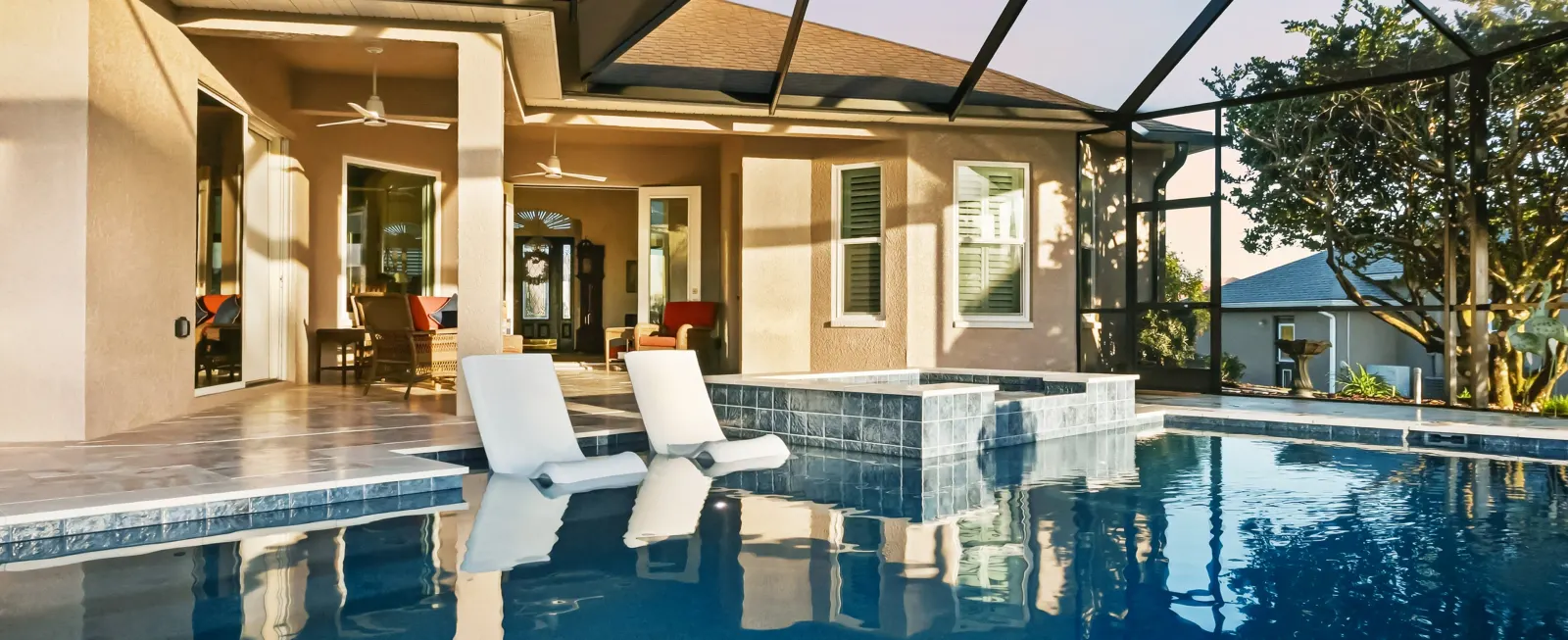
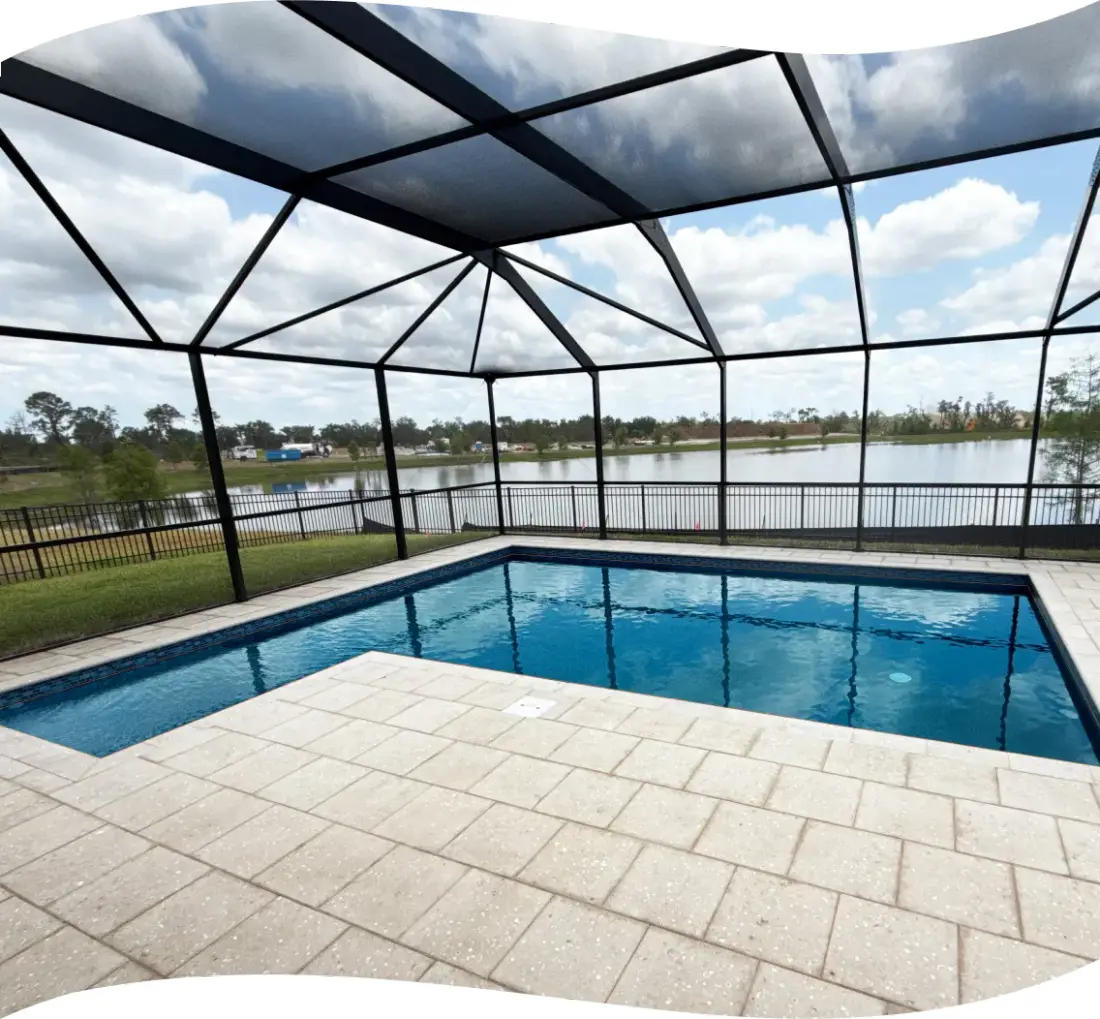
A screen enclosure is the physical control UF/IFAS names for a pool. Among its practical measures, Living with Lovebugs lists screens placed over decks and swimming pools, plus a fan near outdoor recreation areas to keep lovebugs away.
Pool Pros projects have included screen enclosures with finer insect mesh. The Lake Jovita pool and spa project, for one, pairs its enclosure with noseeum screening to reduce insects.
An enclosure moves the cleanup from the skimmer to the screen. Lovebugs that meet the mesh stay on it instead of drifting into the water, and they rinse off easily before the sun bakes them on. Owners with a cage already know the routine from oak pollen season, when the mesh collects a film that the next rain would otherwise wash into the pool.
Each flight lasts about four weeks. The Pool Pros advice for those weeks is short: empty the baskets, hold the water level, and skim before dark.
References
Sources cited in this article:
- UF/IFAS EDIS ENY-840/IN694: Living with Lovebugs, Norman C. Leppla (retrieved September 14, 2026)
- UF/IFAS EDIS Featured Creatures EENY 47/IN204: Lovebug, Plecia nearctica Hardy (retrieved September 14, 2026)
- Pentair: IntelliFlo3 VSF and IntelliPro3 VSF Installation and Maintenance Guide (retrieved September 14, 2026)
- Hayward: Super Pump Series Owner's Manual, IS26001 Rev-B (retrieved September 14, 2026)
- CDC: Home Pool and Hot Tub Water Treatment and Testing (retrieved September 14, 2026)
- Pool Pros: Lake Jovita pool and spa project
Ready to talk about your own pool?
Tell us about the space you have and the pool you're picturing — we'll take it from there.