
September 29, 2026
Storm Surge vs Rainfall Flooding: What Each Does to a Pool
Surge is seawater with waves, debris and scour. Rain flooding is fresh water and saturated ground. What each does to a Tampa Bay pool and what AE and VE mean.
By Pool Pros (CPC1461047) · September 29, 2026 · Homeowner Resources
Storm surge is seawater pushed ashore with waves and debris, so a surged pool can take in far more salt than its equipment is built for, plus sediment, while the deck faces erosion. Rainfall flooding is fresh water that overfills and dilutes the pool and saturates the ground. FEMA's VE zones mark coastal land where storm waves add to flooding.
A flooded pool looks the same either way: brown water to the coping and a deck full of debris. What got into it, and what it did on the way, depends on whether the water came from the sky or the sea.
Pool Pros Construction has built pools on the water in Shore Acres and inland in Dade City, and the two floods ask very different things of a pool.
What is the difference between storm surge and rainfall flooding?
Storm surge is the sea coming ashore. NOAA’s National Hurricane Center defines it as an abnormal water level rise generated by a storm over and above the predicted astronomical tide, and notes that surge can travel up rivers and canals well inland. Waves ride on top of it.
Rainfall flooding is fresh water with nowhere to go. The National Weather Service describes water from heavy rainfall gathering quickly in low-lying areas, where it can surround homes and inundate roads, along with rivers and creeks rising over their banks.
| Storm surge | Rainfall flooding | |
|---|---|---|
| Water | Seawater, about 35,000 ppm salt per USGS | Fresh rainwater and runoff |
| Force | Waves and currents; NOAA puts water at about 1,700 pounds per cubic yard | Rising and ponding water |
| What it carries | Sediment and floodborne debris | Yard runoff, soil and debris |
| Ground | Erosion that can undermine foundations | Saturated soil and a rising water table |
| Main pool risk | Salt, sediment, submerged equipment, scour | Overflow, dilution, uplift on a drained shell |
What does storm surge do to a pool?
Storm surge hits a pool with force first. NOAA says extended pounding by waves can demolish any structure not designed for it, and that erosion can undermine and weaken the foundations of buildings that survived the wind. The Florida Division of Emergency Management’s pool guidance lists scour and erosion, wave impacts and floodborne debris among the flood conditions a pool in a flood hazard area has to be designed around.
The water left behind is the second problem. USGS says ocean water contains about 35,000 ppm of salt. Hayward specifies 2,700 to 3,400 ppm for its AquaRite salt system, and Pentair’s IntelliChlor guide warns that salt above 4,500 ppm may cause excessive corrosion or deterioration. A surged pool can hold far more salt than a salt system is designed for.
Salt does not filter out. Hayward’s manual says the only way to lower salt concentration is to partially drain the pool and refill it with fresh water, which on wet ground is a job to plan, not improvise. Pool Pros’ advice after a surge:
- Keep the equipment off. Anything seawater reached needs a professional inspection first, as covered in what to check after a storm before anyone swims.
- Clear debris and sediment before circulation restarts. Sand and wreckage belong in a net, not the pump.
- Test salinity before a salt system runs. Hayward’s AquaRite shuts down when salt is too high.
- Plan the water change with a professional. Partial draining has structural risks on saturated ground.
- Look at the deck edges and the soil under them. Erosion under a deck is a structural question for the builder.
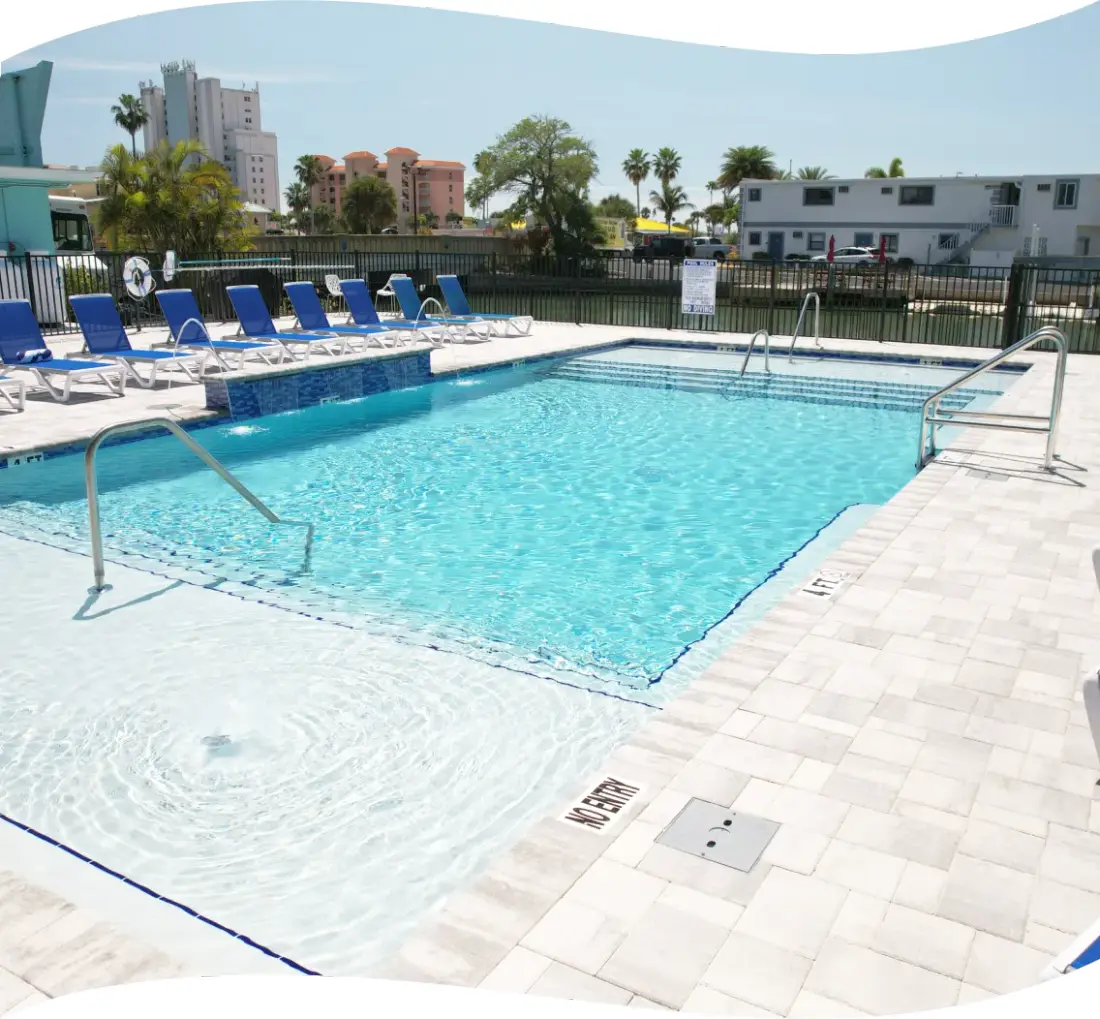
Salt exposure is a design input on the coast. Pool Pros’ write-up of the Sea Jay Motel pool in Treasure Island says every material was chosen to withstand a high-traffic, saltwater environment.
What does rainfall flooding do to a pool?
Rainfall flooding mostly works on the water level and the ground. UF/IFAS Extension points out that a pool is made to hold water and can handle being filled to overflowing, with excess water draining off over the deck.
- Dilution. Hayward’s AquaRite manual says salt is lost mainly when water leaves the pool, including draining because of rain, and that stabilizer usually drops with it.
- Saturated ground. USGS explains that precipitation recharges groundwater and that the water table changes with rainfall patterns. UF/IFAS Extension warns that the water in saturated ground around even a partially drained pool could crack it.
- Uplift. The Florida Building Code requires an approved hydrostatic relief device in areas of anticipated water table (R4501.21.4), and the high water table in Pinellas is why that valve matters there.
That is the reason draining a pool around a hurricane is a mistake. Rainwater in the pool is a chemistry chore. An empty shell in wet ground is a structural risk.
What do AE and VE flood zones mean for a pool?
FEMA’s flood zone letters describe the flood a lot is mapped for. FEMA calls areas with a 1% annual chance of flooding Special Flood Hazard Areas, labeled with A or V zones:
- Zone AE: at least a 1% annual chance of flooding, with wave heights under 3 feet.
- Coastal A Zone: landward of a V zone, where Pinellas County says 1.5 to 3 foot breaking waves are possible in a base flood.
- Zone VE: coastal areas with a 1% or greater chance of flooding plus an additional hazard from storm waves, which FEMA calls a Coastal High Hazard Area.
The letter changes the pool design. The Florida Division of Emergency Management says NFIP communities must permit all development in these areas, including pools and their equipment. In Zone V and Coastal A Zones, its guidance says pools must comply with ASCE 24: elevated, designed to break away without damaging debris, or built to stay in the ground without obstructing flow in a way that damages any structure. Pool equipment below the required elevation must be elevated as far as practical, anchored against flotation and supplied by GFCI-protected circuits.
Why is a coastal Pinellas pool different from an inland Pasco pool?
Coastal Pinellas can face both kinds of flood. Pinellas County says everyone in the county is in a flood zone, and the City of St. Petersburg describes Shore Acres as among the most flood-prone neighborhoods in Pinellas, with frequent tidal impacts and intense rain events. The city’s flood mitigation project there includes a stormwater pump station, box culverts, back flow preventers and raised roadway segments.
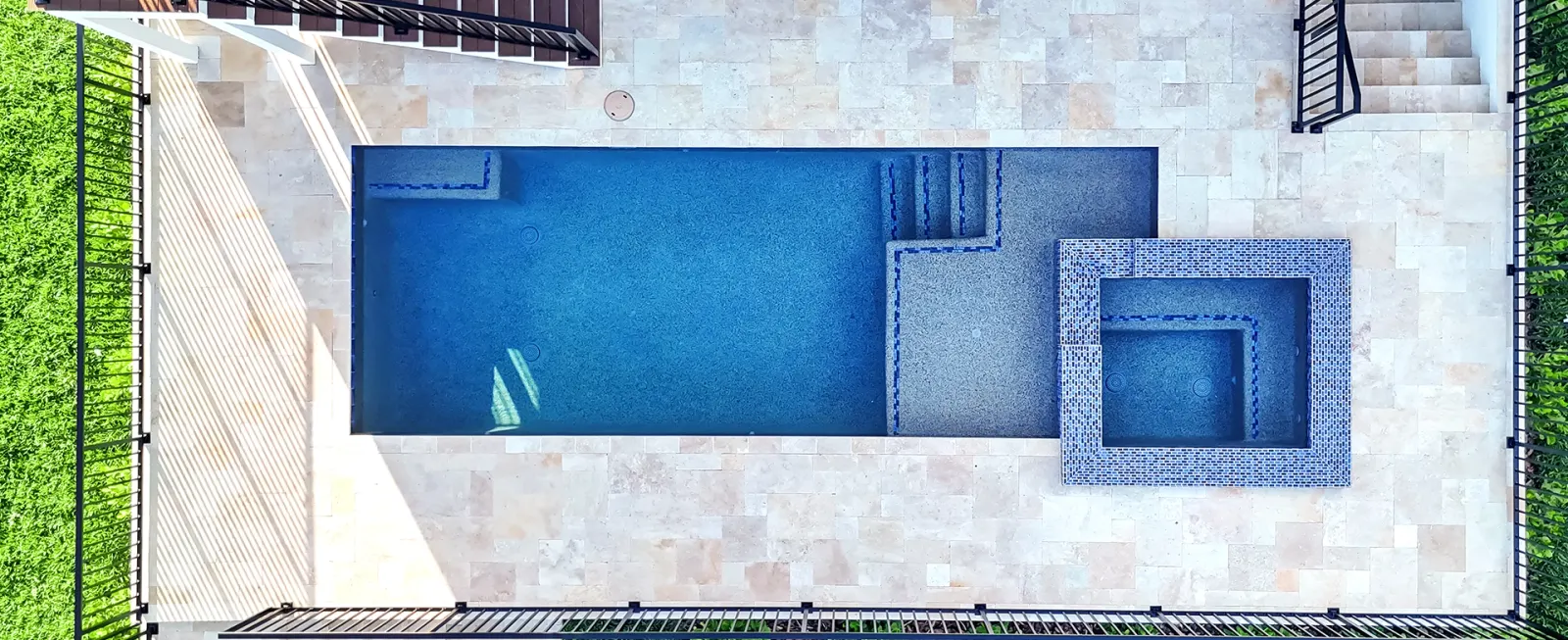
Pool Pros built an elevated pool and spa in Shore Acres, and the company’s own write-up says building elevated in a flood zone adds complexity.
Inland Pasco’s flood risk runs through rivers and creeks. Pasco County’s flood program lists stream gauges on the Anclote and Pithlachascotee rivers, Cypress Creek and Trout Creek near Wesley Chapel, and the Hillsborough River near Zephyrhills. FEMA’s V zones are coastal by definition, so a pool near an inland Pasco creek is designed around rising fresh water and saturated ground, not storm waves.
Check the flood map for the exact lot before the design is fixed. The zone letter belongs in the design from the first drawing.
Northeast St. Petersburg is the local example. WUSF reported that by midday on September 26, 2024, Hurricane Helene’s surge had covered Snell Isle, Shore Acres, Venetian Isles and neighboring bayfront streets with bay water. Pool Pros builds in those neighborhoods, in ZIP codes 33702, 33703 and 33704, as covered in pools in northeast St. Pete.
References
Sources cited in this article:
- NOAA National Hurricane Center: Storm Surge Overview (retrieved September 14, 2026)
- National Weather Service: Flood Related Hazards (retrieved September 14, 2026)
- FEMA: Flood Zones glossary (retrieved September 14, 2026)
- FEMA: Zone VE and V1-30 glossary (retrieved September 14, 2026)
- FEMA: Features of Flood Insurance Rate Maps in Coastal Areas (retrieved September 14, 2026)
- Florida Division of Emergency Management, Office of Floodplain Management: Guidance for Swimming Pools, Spas, and Similar Water Features in Flood Hazard Areas, January 2024 (retrieved September 14, 2026)
- Pinellas County: Flood Maps and Zones (retrieved September 14, 2026)
- City of St. Petersburg: Shore Acres Resiliency Infrastructure (retrieved September 14, 2026)
- City of St. Petersburg: St. Pete Invests 1 Million Dollars in Shore Acres Flood Mitigation Project, December 11, 2025 (retrieved September 14, 2026)
- Pasco County: Flood Program (retrieved September 14, 2026)
- USGS Water Science School: Saline Water and Salinity (retrieved September 14, 2026)
- USGS Water Science School: Aquifers and Groundwater (retrieved September 14, 2026)
- Hayward: AquaRite Electronic Chlorine Generator Owner's Manual, 092540 Rev G (retrieved September 14, 2026)
- Pentair: IntelliChlor Salt Chlorine Generator Installation and User's Guide, IC15/IC20/IC40/IC60 (retrieved September 14, 2026)
- UF/IFAS Extension Indian River County: Pools and Hurricanes, Yvonne Florian (retrieved September 14, 2026)
- Florida Building Code, Residential (2023, 8th ed.), Chapter 45, R4501.21.4 (retrieved September 14, 2026)
- Pool Pros: Elevated pool and spa build, Shore Acres
- Pool Pros: Treasure Island
- WUSF: Storm surge from a distant Helene creates major problems around the Tampa Bay area, September 27, 2024 (retrieved September 23, 2026)
Ready to talk about your own pool?
Tell us about the space you have and the pool you're picturing — we'll take it from there.