
October 27, 2026
Salt vs Chlorine Pools on the Gulf Coast
A salt pool is a chlorine pool with a generator. On a Gulf coast lot, salt air already works on metal. What salt adds for stone, equipment and upkeep.
By Pool Pros (CPC1461047) · October 27, 2026 · Homeowner Resources
A salt pool is still a chlorine pool: an electrolytic cell turns dissolved salt into chlorine. On the Gulf coast the choice matters less for the water than for what surrounds it. Salt in the pool adds exposure for stone and metal that salt air already stresses, and the cell needs steady flow, the right salt level and periodic cleaning.
On a lot within sight of the Gulf, the salt air was there before the pool. That changes which differences between a salt pool and a chlorine pool actually matter.
Is a salt water pool a chlorine pool?
A salt water pool is a chlorine pool with its own chlorine factory. CDC’s Model Aquatic Health Code Annex describes how the systems work: salt is added to balanced pool water, a low-voltage current passes through that water in an electrolytic cell, and the reaction produces chlorine, which becomes the free chlorine that sanitizes the pool.
Hayward’s AquaRite manual says the same in plainer terms. The unit converts salt into free chlorine, and the chlorine reverts to sodium chloride after it does its work.
So the real choice is between chlorine made on site and chlorine added by hand or feeder. Either way, the free chlorine has to be tested. Pentair’s IntelliChlor guide says its generator only produces chlorine and does not monitor or control chlorine levels.
How do salt systems and added chlorine compare?
The two approaches differ in how chlorine arrives, not in what sanitizes the water:
| Salt chlorine generator | Added chlorine | |
|---|---|---|
| Source of chlorine | Electrolytic cell converts dissolved salt (CDC MAHC Annex) | Chlorine product dosed by hand or feeder; tablets are commonly trichlor (CDC MAHC Annex) |
| Salt level to hold | 2,700 to 3,400 ppm Hayward; 3,000 ppm Jandy; 3,600 ppm Pentair | No salt target |
| Stabilizer | 30 to 50 ppm cyanuric acid outdoors, per Hayward, Jandy and Pentair | Trichlor and dichlor add stabilizer with every dose (CDC MAHC Annex) |
| During a power outage | No flow, no chlorine (Pentair, Hayward) | Liquid chlorine can be added and brushed in (Pentair) |
| Equipment upkeep | Cell inspection and scale cleaning; cells wear out (CDC MAHC Annex) | Chemical purchase, storage and dosing by the label (CDC) |
| Free chlorine testing | Still required | Still required |
The outage row is the one a hurricane tests. A salt pool that loses its pump for days has no chlorine source until someone adds one, as clearing a green pool after an outage explains.
What does salt air already do to a Gulf coast pool?
Salt air does its work on a coastal lot whether the pool uses salt or not. FEMA’s NFIP Technical Bulletin 8 says salt spray from breaking waves and onshore winds significantly accelerates the corrosion of metal connectors and fasteners, and that high humidity speeds it further.
The distances in that bulletin are worth knowing:
- Airborne salt is greatest near breaking waves and declines rapidly over the first 300 to 3,000 feet from the shoreline.
- Accelerated corrosion has still been reported as far as 5 to 10 miles inland.
- Sheltered spots, such as areas under decks and walkways, can corrode faster than open ones, because rain doesn’t rinse the salt off.
An equipment pad tucked beside a beach house fits that description. Pool equipment manufacturers flag the same exposure: Pentair’s UltraTemp heat pump manual, in its section on water spraying onto the unit, notes that salt water can be an issue near the coast, and Jandy’s VersaTemp manual says to keep sprinklers from spraying on the heat pump to prevent corrosion.
Pool Pros’ own coastal write-ups say as much. The write-up of the Sea Jay Motel pool in Treasure Island says every material was selected for its ability to withstand a high-traffic, saltwater environment.
What does a salt pool add for stone and metal?
A salt pool adds salt at the pool edge, where splash-out lands on coping and deck. USGS puts seawater at about 35,000 ppm of salt, and Pentair notes that a salt system’s levels are relatively low by comparison. Pentair still states that any salt in a pool increases the likelihood of corrosion or deterioration of equipment and surrounding surfaces.
All three chlorinator makers put their cautions in writing:
- Pentair: metal parts and certain natural and man-made surfaces are particularly susceptible, so consult a pool professional on materials for your pool type and location.
- Hayward: before pairing a saline pool with natural stone coping or decking, consult a qualified stone installation specialist on stone type, installation, sealant and maintenance.
- Jandy: metal components around a pool should be high-grade stainless steel, natural stones vary widely in porosity and hardness, and masonry should be sealed and resealed on the sealer maker’s schedule.
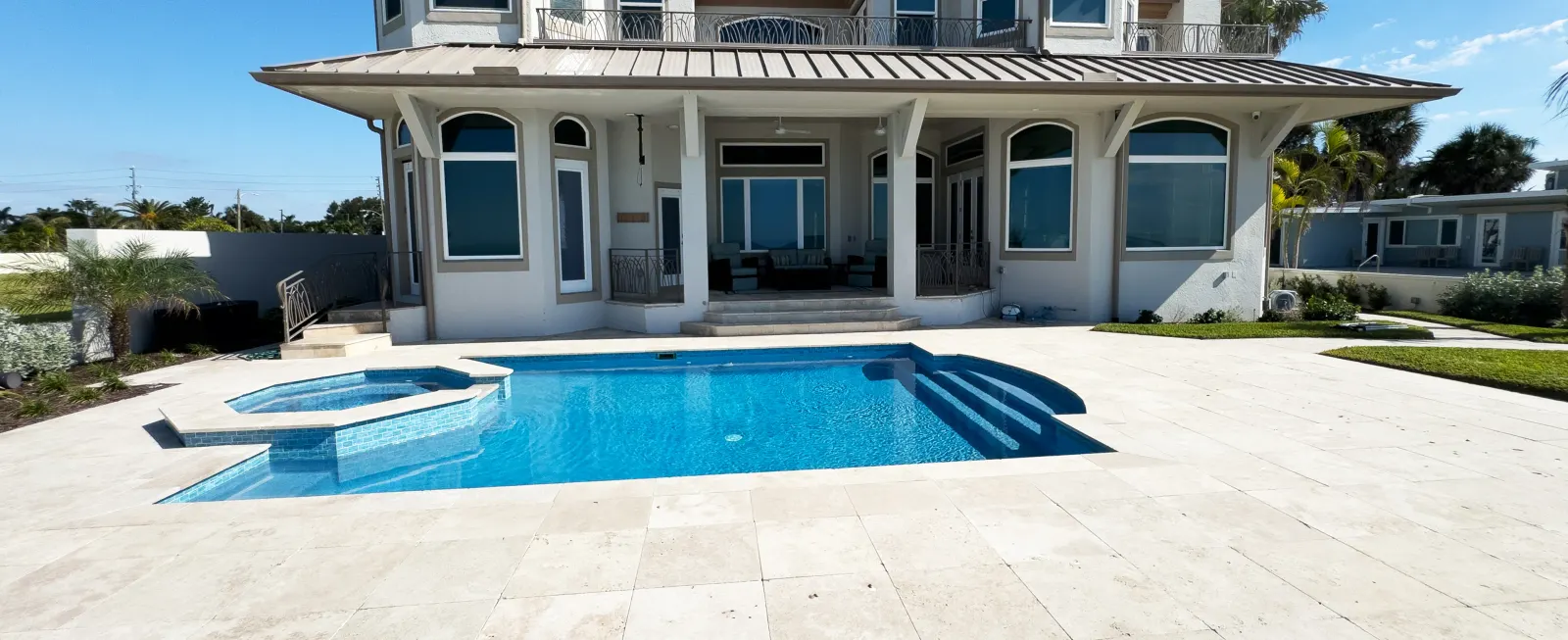
Jandy’s caution also covers acids, chlorine and stabilizers, not only salt, so stone and metal choices deserve care on any pool. Pool Pros’ Shore Acres build pairs a Jandy TruClear salt system with ivory travertine decking and coping, the kind of pairing those manuals ask owners to plan for.
What keeps a salt system healthy in a Tampa Bay summer?
A salt system stays healthy when its salt level stays in range, and summer rain works against that. Hayward’s AquaRite manual says salt is lost mainly when water leaves the pool, including draining after rain, and that stabilizer usually drops along with it. Summer rain’s effect on pool chemistry covers the stabilizer side.
- Test before adding salt. Hayward advises a professional salt check before adding large quantities, and Jandy says to add conservatively because diluting is harder than topping up.
- Stay under your heater’s limit. Jandy’s JXi and VersaTemp manuals both cap pool salt at 4,500 ppm, and Pentair warns that salt above 4,500 ppm may cause excessive corrosion.
- Don’t run the cell starved. Jandy says salt below 2,500 ppm causes premature cell failure, and Pentair’s IntelliChlor shuts off below 2,600 ppm.
- Inspect the cell for scale. Hayward recommends a visual inspection every 3 months or after cleaning the filter, but Jandy notes that excessive cleaning can shorten cell life.
- Keep metals out. Pentair says copper, iron and manganese can damage the cell, which matters on well water; see testing well water for iron before you fill.
Plumbing order matters too. Jandy’s heater manuals call for the chlorinator downstream of the heater with a check valve between them, and Pentair says it designs its IntelliChlor cell for about 10,000 hours, roughly five years of average use.
Which should a coastal Tampa Bay pool use?
Both approaches work on the coast, and Pool Pros’ portfolio has both. The beachfront Belleair Shore pool runs a Pentair I-Chlor30 salt system. The Sea Captain Resort aquatic center in Clearwater Beach holds its chemistry with a Hayward CAT2000 PP controller and redundant Stenner injection pumps.
The deciding questions on a coastal lot are practical:
- Materials: will the coping, deck and railings tolerate salt splash, and who reseals the stone?
- Outages: is someone available to add chlorine when a storm stops the pump?
- Equipment: does the heater’s salt limit leave room for a rainy season of salt additions?
- New finish: Hayward says to wait 10 to 14 days before adding salt to new plaster, Pentair says at least one month and Jandy at least 30 days.
Pentair, Jandy and Hayward all appear among the pool equipment systems on Pool Pros builds, and every new Pool Pros pool gets 28 days of startup maintenance while the interior finish cures and the chemistry balances.
References
Sources cited in this article:
- CDC: 2024 Annex to the Model Aquatic Health Code, 5th Edition (retrieved September 14, 2026)
- FEMA: NFIP Technical Bulletin 8, Corrosion Protection for Metal Connectors and Fasteners in Coastal Areas, June 2019 (retrieved September 14, 2026)
- Pentair: IntelliChlor Salt Chlorine Generator Installation and User's Guide, IC15/IC20/IC40/IC60, P/N 520589 Rev. R (retrieved September 14, 2026)
- Hayward: AquaRite Electronic Chlorine Generator Owner's Manual, 092540 Rev G (retrieved September 14, 2026)
- Jandy: TruClear Chlorine Generating System Installation and Operation Manual, H0613500 Rev G (retrieved September 14, 2026)
- Jandy: JXi Gas-Fired Pool and Spa Heater Installation and Operation Manual, H0574300 (retrieved September 14, 2026)
- Jandy: VersaTemp JRT Series Heat Pump Installation and Operation Manual, H0744700 Rev H (retrieved September 14, 2026)
- Pentair: UltraTemp Heat Pump Installation and User's Guide (retrieved September 14, 2026)
- Pentair: Assessing Your Pool After a Power Outage (retrieved September 14, 2026)
- USGS Water Science School: Saline Water and Salinity (retrieved September 14, 2026)
- Pool Pros: Belleair Shore pool project
- Pool Pros: Elevated pool and spa build, Shore Acres
- Pool Pros: Clearwater Beach
Ready to talk about your own pool?
Tell us about the space you have and the pool you're picturing — we'll take it from there.