
October 29, 2026
Pinellas Pool Permits: Coastal Construction and Flood Zones
Who permits a pool in Pinellas County, when a Gulf-front lot needs an FDEP coastal construction permit, and what VE and AE flood zones change for a pool.
By Pool Pros (CPC1461047) · October 29, 2026 · Homeowner Resources
Pinellas County permits pools in unincorporated areas and in towns such as Belleair Shore, while St. Petersburg, Clearwater, Gulfport and Treasure Island run their own building departments. Seaward of the state's Coastal Construction Control Line, FDEP rules apply as well, and a pool in a VE or Coastal A zone must meet ASCE 24 under the Florida Building Code.
A pool on the Pinellas waterfront can answer to three authorities before it holds water. One is a building department. One is the Florida Department of Environmental Protection (FDEP). The third is the flood zone printed on FEMA’s map, and which of the three apply depends on the parcel.
Who issues a pool permit in Pinellas County?
Pinellas County’s list of building departments says the county’s Building and Development Review Services issues permits for unincorporated Pinellas. The same office issues permits for Belleair Beach, Belleair Shore, Indian Rocks Beach, Kenneth City, Safety Harbor and Oldsmar. St. Petersburg, Clearwater, Gulfport and Treasure Island each list their own building department.
| Where the parcel is | Permitting office |
|---|---|
| Unincorporated Pinellas County | Pinellas County Building and Development Review Services |
| Belleair Shore, Belleair Beach | Pinellas County Building Services |
| St. Petersburg | City of St. Petersburg building permitting |
| Clearwater | City of Clearwater Permits and Inspections |
| Gulfport | City of Gulfport community development |
| Treasure Island | City of Treasure Island Building Department |
The county’s list tells owners to confirm the municipality by searching the address on the Pinellas County Property Appraiser site. For Belleair Shore, that means a county permit. For Treasure Island and St. Petersburg, the city issues the permit.
What does Pinellas County ask for with a pool permit?
Pinellas County’s Permit Submittal Intake Checklist lists potential requirements by permit type. On a Pool Pros build, engineers draw the plans and Pool Pros manages this paperwork, step two of the Pool Pros build process. For a pool, the listed items include:
- A Habitat Permit Form for exterior work or new construction.
- Building plans, most with a digital signature and seal.
- A boundary or topographic survey issued within the last five years, with a plot or site plan.
- A recorded Notice of Commencement for building work valued over $5,000, the same threshold explained in the Pasco County pool permit guide.
- A no-objection letter from the electric company, listed for pools.
- A Safety Act letter, listed as required for pools.
- A Florida Department of Health letter or permit where the property is on septic.
What is the Coastal Construction Control Line?
Section 161.053, Florida Statutes, directs FDEP to set a Coastal Construction Control Line county by county along the state’s sand beaches. The line marks the part of the beach-dune system subject to severe fluctuations based on a 100-year storm surge, storm waves or other predictable weather conditions. Once a line is filed, the statute bars anyone from building a structure, excavating, removing beach material or otherwise altering ground elevations seaward of it, except as the statute provides.
FDEP says the program regulates structures and activities that can cause beach erosion, destabilize dunes, damage upland properties or interfere with public access. The permits also protect sea turtles and dune plants.
Pinellas County’s floodplain code makes the link to local permits explicit. Section 158-68 conditions floodplain development and building permits on obtaining other applicable state permits before work starts, including FDEP’s for activities seaward of the control line. Section 158-81 asks site plans to show the line where it applies.
How does FDEP treat a pool seaward of the control line?
FDEP’s rules classify swimming pools as nonhabitable major structures (rule 62B-33.002, F.A.C.). Rule 62B-33.005(8) then sets the pool standard:
- Pools, spas and similar water structures are expendable and must be sited so their failure does not harm the beach and dune system, adjoining major structures or coastal protection structures.
- A pool close to a significant dune must be elevated partially or totally above the original grade to minimize excavation, with no net loss of material from the immediate area.
- Every pool must be designed to minimize permanent excavation seaward of the control line.
The same rule requires construction to cause no net excavation of in situ sandy soils seaward of the line. Excavated sand stays on site, seaward of the line, unless FDEP authorizes otherwise.
Section 161.053 also lets FDEP condition the timing and sequence of construction to protect nesting sea turtles, which can shape a Gulf-front build schedule. Under section 161.053(18), a pool serving a single-family home may qualify for a general permit. The pool must not advance the line of existing construction and must meet all siting and design requirements.
What changes between a VE and an AE flood zone?
FEMA defines Zone VE as coastal areas with a 1 percent or greater chance of flooding and an additional hazard associated with storm waves. FEMA defines Zone AE as the base floodplain where base flood elevations are provided. The Florida Division of Emergency Management’s pool guidance explains that Florida Building Code requirements for pools differ by zone:
| Flood zone | What the code focuses on for a residential pool |
|---|---|
| Zone A or AE, landward of a Limit of Moderate Wave Action | Section R322.2.5. The main question is whether an above-ground pool, or an in-ground pool involving fill, sits in a designated floodway. |
| Coastal A Zone | ASCE 24 under section R322.3.3.1, the same as Zone V. |
| Zone V or VE | ASCE 24 under section R322.3.3.1. Elevate the pool, design it to break away without damaging debris, or keep it in the ground without obstructing flow. |
The same guidance describes Coastal A Zones as areas subject to wave heights of 1.5 to 3 feet, seaward of the Limit of Moderate Wave Action. In Zone V and Coastal A Zones, the guidance warns, a pool rising above grade and dressed with nonstructural fill to look flush is not fully in-ground and counts as an obstruction.
What about the enclosure and equipment near the water?
The Division of Emergency Management’s guidance says a pool in any flood zone may be surrounded by lattice, insect screening, decorative concrete block or aluminum screening that lets floodwater pass. Breakaway walls, walls with flood openings and glass walls do not meet that standard.
Pool equipment may sit below the base flood elevation plus freeboard only if elevated to the extent practical, anchored against flotation and flood forces, and supplied by ground-fault protected circuits. Water under the lot matters too. The high water table in Pinellas changes how a pool is built, and storm surge and rainfall flooding do different things to a pool afterward.
How does a Pool Pros build handle a flood zone?
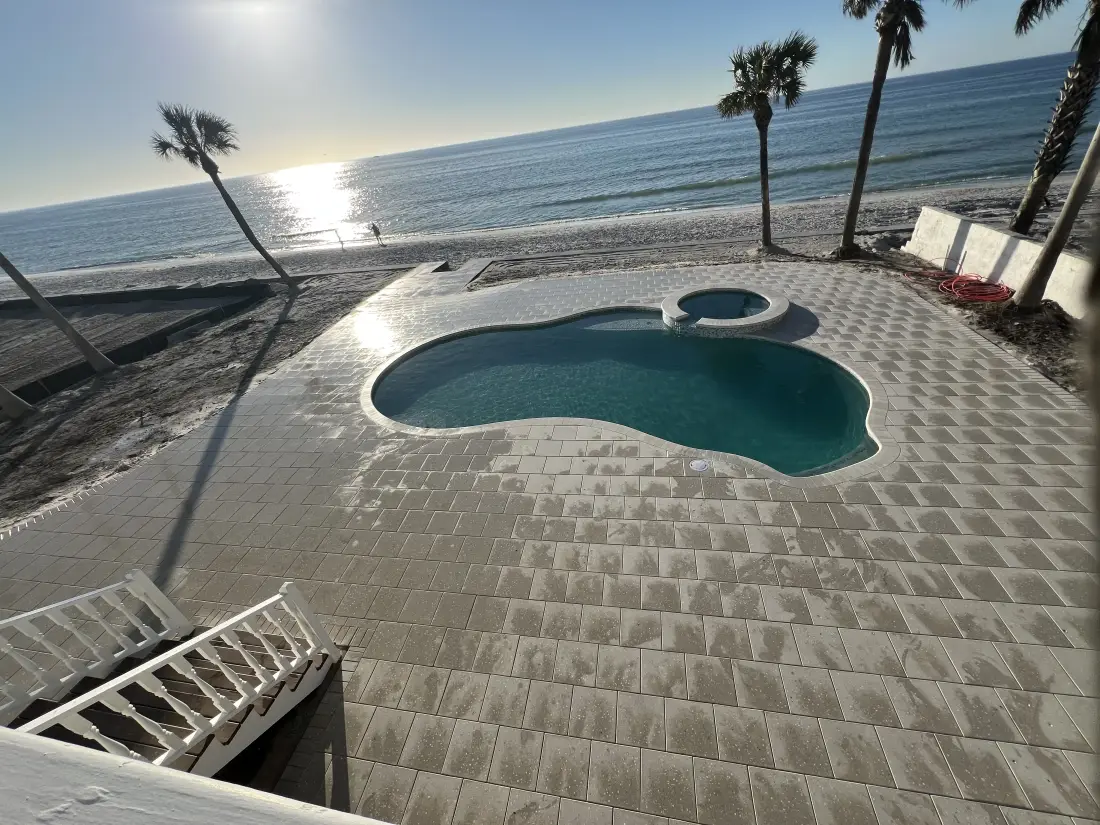
Pool Pros Construction has built on the Pinellas waterfront, including the elevated pool and spa in Shore Acres. Pool Pros’ project write-up says building elevated in a flood zone adds complexity, and credits the builder and pool contractor being on the same page from day one.
The same order applies on any coastal lot. Confirm the permitting office, the flood zone and the control line before the design is fixed, since each one can change where the pool sits and how the shell is built. Hillsborough County’s pool checklist asks for similar ASCE 24 flood design statements, covered in how long a Hillsborough pool permit takes.
The same county list decides remodels. Pinellas County issues permits for Safety Harbor and Oldsmar as partner communities, while Tarpon Springs, Seminole and Largo run their own departments, and unincorporated Palm Harbor is a county permit. Pool Pros maps each of its north and mid Pinellas remodel ZIP codes, 34683, 34685, 34688, 34689, 34677, 34695, 33776, 33777 and 33713, to its office in Pinellas pool remodel permits by ZIP code.
References
Sources cited in this article:
- Pinellas County: Building Departments in Pinellas County (retrieved September 14, 2026)
- Pinellas County: Permitting Guide and Permit Submittal Intake Checklist (retrieved September 14, 2026)
- Pinellas County Code, Chapter 158 Floodplain Management, Sections 158-2, 158-68 and 158-81, Supp. No. 124 (retrieved September 14, 2026)
- Pinellas County: Construction in a Floodplain (retrieved September 14, 2026)
- The Florida Legislature: 2026 Florida Statutes, Section 161.053 Coastal construction and excavation (retrieved September 14, 2026)
- Florida Department of Environmental Protection: Coastal Construction Control Line Program (retrieved September 14, 2026)
- Florida Administrative Code, Chapter 62B-33, Rules 62B-33.002 and 62B-33.005 (retrieved September 14, 2026)
- Florida Division of Emergency Management, Office of Floodplain Management: Guidance for Swimming Pools, Spas, and Similar Water Features in Flood Hazard Areas (retrieved September 14, 2026)
- FEMA: Zone VE and V1-30 (retrieved September 14, 2026)
- FEMA: Zone AE and A1-30 (retrieved September 14, 2026)
- Pool Pros Construction: Elevated Pool and Spa Build, Shore Acres
See it built
Ready to talk about your own pool?
Tell us about the space you have and the pool you're picturing — we'll take it from there.